

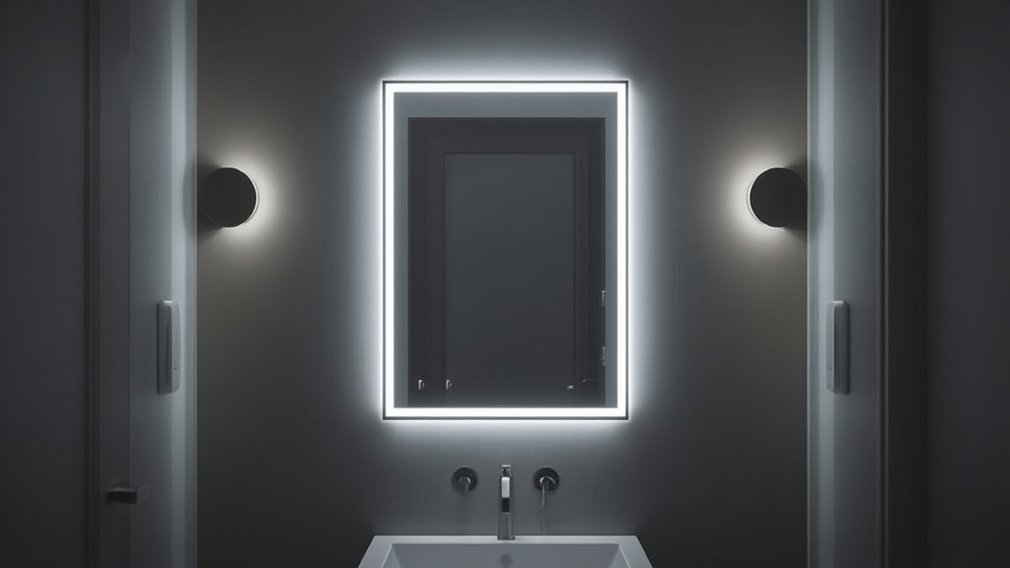
Smart mirror technology is shaking up bathroom remodels, but evidence-based answers are in short supply. If you’re evaluating a digital bathroom mirror with built-in display for your home, you’ll want more than vendor promises—you need hard market data, clarity on feature value, and a checklist to avoid privacy and support risks. This guide delivers all that, including key information gaps the major reports miss so you can make a confident, future-proof decision.
Key Takeaways
- The smart mirror market in 2024 is estimated anywhere between $584M and $3.7B globally, with key reports projecting rapid growth—though major uncertainties remain.
- Top market data omits real user satisfaction, comparative pricing, and privacy/safety disclosures, so hands-on research is crucial before purchasing.
- This guide presents actionable evaluation steps and a checklist so you don’t buy blindly or get caught off guard by hidden costs or limited features.
- 2024 market snapshot — how big is the smart mirror market and where is it headed?
- What buyers want from a digital bathroom mirror (features that matter)
- Pricing and total cost of ownership — what the data shows (and doesn’t)
- User experience and complaints — review evidence (what we found and what’s missing)
- Leading brands and models in 2024 — the current state of public information
- Security & privacy — what is publicly known and key unknowns
- Top 3 information gaps readers care about (and why they matter)
- Real-world utility — do weather and schedule displays materially improve morning routines?
- Practical buyer checklist — how to evaluate and compare smart/digital bathroom mirrors
- Recommended next-step research for this article (primary reporting tasks for the writer)
- Conclusion
- Frequently Asked Questions
2024 market snapshot — how big is the smart mirror market and where is it headed?
Expect a lot of hype—and a lot of confusion. The global smart mirror market size for 2024 differs sharply depending on which vendor you ask. Some reports pin it at $584.82 million [SkyQuest], others claim $1.8 billion [GM Insights], $3.1 billion [Strategic Market Research], $3.3 billion [Research and Markets], or even $3.68 billion [ElectroIQ]. US-specific numbers for 2024 hover around $500 million, up sharply from just $206 million in 2022.
Growth forecasts are equally varied. You’ll find estimates as low as 8.1% CAGR (reaching ~$1.09B by 2032) to as high as 20.6% CAGR (projected $23.2B by 2033). Most agree demand for digital bathroom mirrors and mirrors with display features will surge fastest in affluent, smart-home-driven markets.
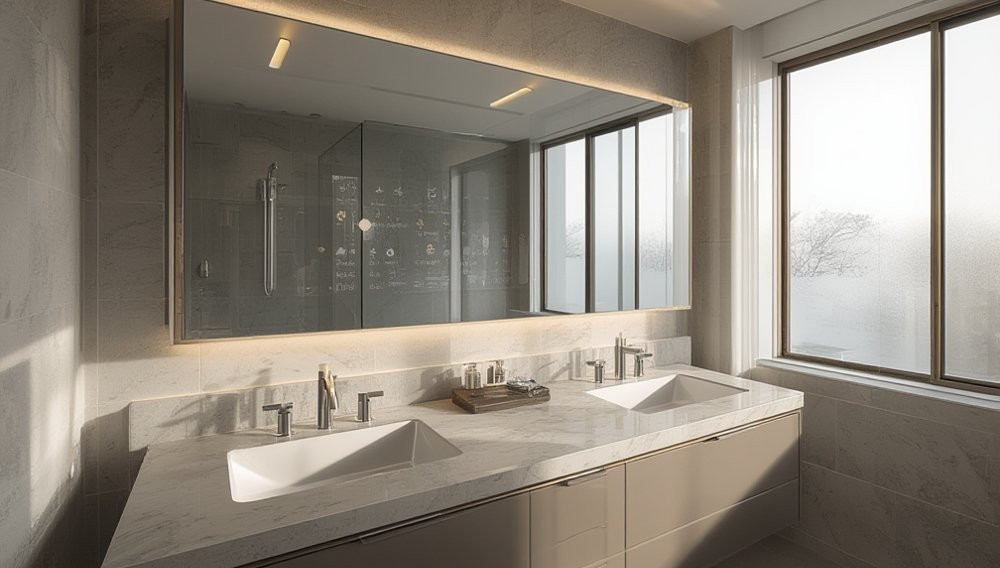
Why do figures diverge so much? Many “market reports” lump together auto and retail use cases alongside home setups. Others count different feature sets. Vendor investment is strong, but the real size and future spending power in the digital bathroom mirror space depends on consumer trust and experience—where most published research admits gaps.
If you want more on bathroom remodel costs for planning your project’s overall budget, see our Ultimate Complete Guide to Kitchen and Bathroom Remodel Costs and Planning.
What buyers want from a digital bathroom mirror (features that matter)
For design-focused, tech-pragmatic buyers, a digital bathroom mirror isn’t about gimmicks—it’s about blending daily convenience, reliability, and style. Key features advertised include:
- Weather updates and news at a glance during morning routines
- Integrated calendars and schedules synced from your phone or cloud
- Voice assistant support (Alexa, Google Assistant), often hands-free
- AI-driven personalization (lighting, display widgets, reminders)
- Dimmable LED edge-lighting and touchless controls for vanities
- IoT/smart home integrations (music, bathroom fan, lighting triggers)
Actual use cases tend to split: Morning schedules and weather matter most at the main bathroom mirror; LED lighting and makeup/skin analysis tools are more valued at the vanity. Expect rising residential demand for these digital bathroom mirrors in premium remodels—especially where privacy controls and aesthetic minimalism are priorities, according to recent market overviews.
For more ideas balancing function and luxury, see Spa Bathroom: 7 Amazing Ways To Create A Luxury Retreat.
Pricing and total cost of ownership — what the data shows (and doesn’t)
No public research report provides a head-to-head cost breakdown between a mirror with display versus a classic bathroom mirror. Here’s what’s missing:
- No published retail price comparisons for similar size/quality mirrors
- No aggregated installation, wiring, or smart home integration costs
- Zero reporting on maintenance, software updates, or electronic part replacements over time
- No total cost of ownership (TCO) calculator models
That means you’ll need to estimate TCO yourself: add purchase price, electrical/IoT installation, annual software/subscription fees if any, budget for 3-5 year hardware updates, and factor in any need for professional maintenance.
If you want broader context on budgeting for functional, modern bathrooms, our Bathroom Remodels That Enhance Style and Function guide provides benchmarking tips.
User experience and complaints — review evidence (what we found and what’s missing)
You’ll find dozens of reports touting exploding demand for interactive bathroom mirrors, but none aggregating real-world user complaints or satisfaction rates. Here’s what to look out for based on expert buyer checklists and reviews scattered across the web:
- Touch responsiveness—laggy, inaccurate, or “dead” touch zones
- Display readability in bright daylight—or glaring reflections
- Weather/calendar widgets not syncing or updating in real time
- Frequent software bugs or app crashes
- Difficulty integrating with non-mainstream smart home platforms
- Problems with Wi-Fi or Bluetooth connections dropping
- Mounting, fit, and size issues in older or custom vanities
Market reports ignore these negatives, focusing only on feature adoption rates and vendor investment. For genuine insight, comb through independent retail or forum reviews and note the recurring complaints instead.
Leading brands and models in 2024 — the current state of public information
Want a ranked list of the “best” LED smart mirror brands? Sorry—nearly all major 2024 smart mirror market reports do not name top consumer brands, show tech specs, or compare user satisfaction in detail. Instead, they describe feature categories: screen sizes (from 10” to over 40”), Wi-Fi/Bluetooth/Ethernet options, built-in voice assistants, and a “proprietary app ecosystem.”
Until primary testing data is available, compare models by:
- Screen size and brightness (ensure it fits your vanity and daytime use)
- Connectivity (Wi-Fi, Bluetooth, Ethernet), especially if you already have a robust smart home setup
- OS/firmware update policy, commitment to long-term software support
- Does it work with your preferred voice assistant: Alexa, Google, Siri?
- App ecosystem (third-party integrations, scheduling, weather, energy use tracking)
If evaluating smart home system compatibility, see Smart Home Voice Control: 7 Best Ways to Maximize Convenience for a platform overview.
Security & privacy — what is publicly known and key unknowns
For any interactive mirror handling your calendar, reminders, or personal photos, privacy and security are paramount. The problem? Reviewed 2024 sources contain no in-depth model-level security or vulnerability history reports [ElectroIQ]. Standard controls to demand include:
- Local processing options (no cloud upload unless needed)
- Encrypted local storage if personal info is stored
- End-to-end encryption for all cloud communications
- Clear, accessible privacy policy—not hidden in vendor footnotes
- Physical switch or secure app control to disable cameras/mics
- Over-the-air update capability for prompt security patches
Absence of published security commitments means you need to quiz vendors directly—never take built-in privacy for granted.
If you want advanced tips on choosing smart bathroom tech that protects your privacy, read our Touchless Bathroom Faucets: 7 Best Ways to Maximize ROI guide for IoT best practices.
Top 3 information gaps readers care about (and why they matter)
Despite dozens of market reports, our evidence synthesis highlights three major “blind spots” for buyer research in 2024:
- Real-user feedback on weather and schedule integration: No published data on whether these daily-use features actually work reliably under real conditions, or if consumers abandon them after initial setup.
- Detailed privacy and data-storage practices or breach tracking: Not a single market report details concrete security mechanisms, audit trails, or past vulnerability incidents for interactive bathroom mirrors.
- Comparative performance metrics across models: No reliable way to compare latency, accuracy of updates, or display readability under varied lighting—forcing buyers to rely on marketing claims or scattered user anecdotes.
Each gap has direct implications for buyer risk, long-term satisfaction, and resale value.
Real-world utility — do weather and schedule displays materially improve morning routines?
Current market research acknowledges rising demand for smart mirror display features but fails to offer user surveys or testimonials demonstrating actual utility. There’s no data on:
- How many buyers actually use calendar or weather features daily
- If these integrations improve punctuality, decision-making, or stress reduction in the mornings
- User stories or diary studies capturing real experience over time
For credible answers, you need first-hand surveys, guided usability tests, or at least diary studies tracking actual engagement over several weeks. Until then, you can only infer value based on market growth rather than real utility.
Practical buyer checklist — how to evaluate and compare smart/digital bathroom mirrors
Here’s a step-by-step smart mirror research and purchase checklist, centered on actionable buyer needs:
- Core features: Weather, schedules, lighting, voice control—list absolute “must-haves” and skip marketing extras
- Display size/brightness: Ensure the mirror is readable in your bathroom’s lighting, fits your vanity, and outputs enough lumens for makeup or shaving
- Connectivity & compatibility: Match Wi-Fi/Bluetooth/IoT features to your smart home system
- Update & support policy: Check if you’ll get at least 2-3 years of firmware updates and confirmed compatibility with changing APIs
- Privacy & data storage: Clarify what’s stored locally, what’s sent to the cloud, and how you can disable or audit these features
- Warranty & support: Look for clear return policies and 1-2 year hardware warranty minimums
- Installation needs and cost: Ask about professional install requirements and hidden wiring upgrades
- Third-party reviews: Search for recurring complaint themes or praise in independent retail/user reviews

This checklist matters more than ever—the market is moving quickly, with new vendors entering a space projected in the billions across only a handful of years. Inconsistent quality and support, jargon-heavy promises, and opaque privacy make care essential. Want to maximize return on design investments? Also browse our resource on Biophilic Bathroom Design for timeless upgrades.
Recommended next-step research for this article (primary reporting tasks for the writer)
To fill critical information gaps and create a truly defensible, buyer-first guide, the following next steps are essential:
- Compile a specs and features table for top smart mirror vendors: screen size, display tech, voice/app support, price, warranty details
- Scrape and synthesize real user reviews from leading online retailers and homeowner forums—categorize most common complaints about usability, reliability, install, feature gaps
- Interview at least 2-3 leading smart mirror brands/vendors: Dig deeply into security policies, firmware update frequency, and dedicated support channels
- Run a user survey targeting at least 200 homeowners who use a smart or mirror with display in their daily routines—quantifying feature engagement, satisfaction, and friction
- Consult a cybersecurity specialist to identify common IoT mirror vulnerabilities, known exploits, and how reputable vendors can address them
Current market reports cover less than half of these; executing these steps is necessary for any future update or in-depth “best LED smart mirror” list.

Conclusion
The evidence-first approach reveals plenty of excitement around smart mirror innovation—but also many unanswered questions for pragmatic buyers. If you want a smart mirror that truly upgrades your mornings or vanity, use the checklist above, demand specific answers from vendors, and factor in the value of privacy and long-term support. Start your research now and revisit this guide as we update it with new primary data.
Ready to transform your bathroom and invest wisely? Bookmark this page and sign up for future updates as our research expands—or browse our proven Energy-Efficient Bathroom Upgrades guide for more smart home ROI tips.
Frequently Asked Questions
What is the average cost of a smart mirror for a bathroom remodel?
There is no published, reliable average, but most high-quality digital bathroom mirrors with integrated displays start around $600 to $2,500, excluding installation and maintenance.
Are smart mirror features—like weather and calendar displays—actually useful?
Market demand is rising for these features, but no current surveys or user testimonials prove increased convenience. Direct feedback is an evidence gap; buyer experience may vary.
Can smart/LED bathroom mirrors be retrofitted into any existing vanity?
Installation may be complex depending on size, mount type, and electrical needs. Some products fit standard vanities; others require custom modification or new wiring.
How secure are interactive smart mirrors with personal info features?
No 2024 research report describes specific security implementations. Look for local processing, encrypted storage, and clear privacy controls, and always confirm policies with the vendor directly.
How do smart mirror warranties compare to traditional mirrors?
Smart mirrors usually offer 1–2 year electronics warranties. Traditional mirrors may have longer lifespans but do not include electronics, so replacement/repair considerations differ.