


Heated bathroom floors are one of the most sought-after luxury upgrades in today’s high-end renovations, but not every project delivers the ROI, energy performance, or comfort that discerning homeowners expect. This guide cuts through marketing hype, using market data plus real-world pitfalls to help you invest wisely, avoid installation mistakes, and maximize the value of your bathroom remodel.
Key Takeaways
- Heated bathroom floors add luxury comfort and silent warmth, but not all systems deliver the same financial or user satisfaction upside—costs and technical trade-offs are significant.
- Hydronic and electric radiant floor heating systems differ in long-term running expenses, installation complexity, and their fit with bathroom size and existing HVAC.
- Most guides ignore three crucial real-world gaps: true user complaints, accurate installation/maintenance cost breakdowns, and strict flooring compatibility rules—this post addresses them all with action steps.
- Market snapshot — why heated bathroom floors are a luxury renovation opportunity
- Hydronic vs. electric radiant floor heating — which is right for a luxury bathroom?
- Average installation & operating cost comparison — what the research shows (and what it doesn’t)
- Energy efficiency and monthly utility impact — realistic expectations for new builds vs. retrofits
- Common user complaints, failure modes & how to mitigate them
- Technical limitations & flooring compatibility — tile and other bathroom surfaces
- Retrofit-specific considerations for luxury bathrooms (timing, disruption, and value engineering)
- Proven homeowner benefits & resale/market signaling — what the data supports (and gaps)
- Three critical gaps competitors don’t cover (editorial checklist)
- Sources to pursue, quotes to secure, and data collection tasks for the writer
- Practical recommendation & CTA for luxury renovation clients
- FAQ
Market snapshot — why heated bathroom floors are a luxury renovation opportunity
If you want to future-proof your home and signal true luxury, heated bathroom floors are a top growth investment according to the latest renovation market data.

Market reports (2024) show the global heated bathroom floor market will reach USD 2.2B by 2025 and nearly double to USD 4.3B by 2033, growing at 13.1% CAGR. The broader underfloor heating sector is worth over USD 5.3B–6.7B now, with luxury and residential renovations (over 50% of installations) driving demand. In fact, 42% of US homes now prefer electric radiant floor heating solutions because they combine efficiency and comfort. High-end bathroom remodels in particular leverage heated floors as a competitive differentiator—for both resale and year-round appeal. For a breakdown of other impactful bathroom upgrades, see our bathroom remodels value guide.
Hydronic vs. electric radiant floor heating — which is right for a luxury bathroom?
If you want maximum comfort and ROI, selecting the right radiant floor heating system type for your specific bathroom is essential—ignore this choice and you risk overspending or underperforming.
Two main options dominate luxury remodels: hydronic radiant floor heating (water-based) and electric radiant floor heating. Hydronic systems—using circulated warm water—control 61.7% of the overall market (market reports, 2024). Their appeal is lower lifetime energy cost, especially in large or multi-zone bathrooms and ease of renewable integration (heat pumps, solar). However, installation is less practical for single bathrooms or limited renovations due to messy integration and higher upfront labor.
By contrast, electric floor warming systems (especially mats or loose wire systems) dominates upgrades in new builds and luxury ensuites because installation is simpler, faster, and easier to pair with smart thermostats and home automation. In the US, 42% of homes now choose electric radiant floor heating (WarmlyYours, 2024), mainly due to retrofitting flexibility and lower disturbance to finishes. If simplicity, precise controls, and minimal schedule disruption matter—or if your project is a smaller ensuite—electric may be the clear winner.
Still comparing broader flooring upgrades? Consult our complete guide to kitchen and bathroom remodel planning for holistic budgeting advice.
Average installation & operating cost comparison — what the research shows (and what it doesn’t)
Be prepared: real-world project costs for heated bathroom floors swing dramatically, especially around labor, system type, and local trades.
Hydronic radiant floor heating incurs higher upfront costs (specialized labor, manifold/pump install) but can be more cost-effective over time for larger square footage or multi-room projects. Electric floor warming systems are often cheaper to install in a single bathroom, with fewer moving parts but potentially higher monthly power costs over years. However, no major market research report or manufacturer published reliable national cost averages for installation, operations, or maintenance (2024 data gap)—prices may double or triple between regions, installers, or seasons.
Always check for hidden ongoing costs—programmable thermostats upgrades, substrate prep, and possible repair callouts—which can erode expected savings. Explore smart budgeting tips in our luxury spa bathroom investment guide.
Energy efficiency and monthly utility impact — realistic expectations for new builds vs. retrofits
Expect true efficiency gains only with the right design, smart controls, and insulation—system type alone is not enough to guarantee lower utility bills.
Hydronic radiant floor heating is best for consistent, all-day warmth with the lowest long-term operating costs, especially when used with modern heat pumps or solar—critical for larger footprints or master bathrooms. Electric floor warming systems shine for their rapid heat-up and spot-use flexibility, saving energy if paired with programmable thermostats and occupancy sensors.
However, market studies do not provide quantified monthly bill savings or direct retrofit performance data. In new builds, floors can be insulated and integrated from the start, maximizing efficiency. Retrofits may see diminished returns if the subfloor or insulation is subpar or if the house envelope is leaky. Pairing heated floors with other energy-saving upgrades? See our energy-efficient bathroom guide for full-stack ROI ideas.
Common user complaints, failure modes & how to mitigate them
If you want lasting satisfaction, don’t ignore the most common complaints—not every heated bathroom floor delivers five-star comfort.
Top-reported user and installer pain points include:
- Sticker shock from unexpectedly high installation expenses, especially with specialty finishes or tight timelines.
- Energy consumption concerns if the system is left running (manual thermostats), or if flooring lacks sufficient insulation below.
- Installation complexity and repair difficulty—hydronic floor leaks or failed electric mats can require major floor demolition to fix.
- Maintenance headaches—access to pumps, manifolds, or failed wires under tile may be costly post-install.
- Limited awareness of warranty terms—some manufacturers void coverage if compatibility or electrical specs are not precisely followed.
How to avoid these issues? Vet all installers, demand written installation and maintenance quotes, insist on programmable thermostats, and document every warranty (including for controls, mats, and thermostats). Review first-person testimonials for recurring frustrations before finalizing your decision. For more real-user complaint analysis, our bathroom remodels guide examines proven strategies for customer satisfaction.
Technical limitations & flooring compatibility — tile and other bathroom surfaces
Don’t let aesthetics ruin performance or warranty: heated bathroom floors have strict technical limits based on your chosen finish and subfloor type.
Tile is the most common and compatible bathroom surface for underfloor heating, offering rapid and even heat transfer. However,:
- Tile heating mats require specific thinset and uncoupling techniques—excessive floor buildup may cause finish/vapor issues.
- Loose wire systems or “DIY” mats demand flat, properly prepared subfloors to prevent cold spots or failed tiles.
- Some systems limit tile thickness or substrate assembly—too thick, and the system’s performance drops sharply.
- Vinyl, engineered wood, and laminate floors must be explicitly tested and rated by manufacturers or warranties may be voided.
Despite marketplace segments including “tile” and “mat” systems (Intel Market Research 2024), no public data quantifies maximum thicknesses, subfloor requirements, or failure rates. Always demand both manufacturer and installer compatibility documentation before committing.
Retrofit-specific considerations for luxury bathrooms (timing, disruption, and value engineering)
If you want heated floors in an existing bathroom, expect more disruption and planning than new construction—minimizing inconvenience requires smart sequencing and careful value engineering.
You’ll need to decide between full remove-and-replace (demolish floor, install new hydronic/electric heat, re-tile) or “overlay” methods with ultra-thin mats suitable for electric systems. Consider floor buildup impacts—adding even half an inch of height may require raising thresholds, toilet flanges, or bathroom cabinetry. Tight coordination between plumber, electrician, tiler, and site supervisor is crucial to avoid costly sequencing errors.

The retrofit segment is booming (HTF Market Insights, 2024), but utility savings are not always clear—watch for inflated performance claims and always benchmark regional installer costs. Need more value mitigation ideas? See our biophilic bathroom design strategies for wellness-centric renovations.
Proven homeowner benefits & resale/market signaling — what the data supports (and gaps)
Heated bathroom floors signal quality and comfort, but the strongest benefits are user experience—not always direct resale price jumps.
Research reports cite even heat distribution, silent operation, and top sustainability marks—especially for electric floor warming systems integrated into smart homes. The residential sector now accounts for 50.33% of market share (Fortune Business Insights, 2024). The residential electric underfloor heating market is projected to nearly double (USD 4.2B to USD 7.8B) by 2034 at 6.4% CAGR—yet no data sources provide quantified resale or user satisfaction metrics. If you’re optimizing for buyer appeal, focus on seamless temperature control, spa-like warmth, and visible luxury materials (such as heated tile and stone). For more resale-boosting ideas, see our fluted cabinets upgrade guide.
Three critical gaps competitors don’t cover (editorial checklist)
If you want a complete picture before making this luxury investment, don’t rely on competitor articles that gloss over crucial decision drivers—here are the critical gaps this guide addresses (and your checklist for further research):
- Real-world complaints and failure rates: Market data rarely captures actual homeowner grievances from reviews or service calls—dig deeper, especially into verified testimonials.
- Granular installation & ongoing cost breakdowns: Most sites cite generic “cost per square foot” but ignore regional labor differences or annual maintenance/repair scenarios—request local quotes.
- Technical compatibility and failure causes: Only manufacturer sheets specify allowable finish types, subfloor build-ups, or invalidating shortcuts—demand this documentation before you sign.
For those planning broad upgrades, compare with our outdoor space renovation cost guide to prioritize budget where it counts.
Sources to pursue, quotes to secure, and data collection tasks for the writer
To accurately inform luxury renovation clients—and fill the gaps left by top-ranking competitor content—successful projects depend on collecting the following first-hand data:
- Request at least three competitive local quotes (hydronic and electric), with explicit cost, disruption, scope, and warranty details.
- Gather 20 homeowner user reviews/testimonials from platforms like Houzz, Google, or manufacturer sites—systematically code for complaints, downtime, and recurring failure patterns.
- Secure official technical installation sheets for every finish type being considered—especially for tile/stone and premium wood overlays.
- Interview an HVAC engineer about heat pump integration and radiant system compatibility for larger luxury bathrooms.
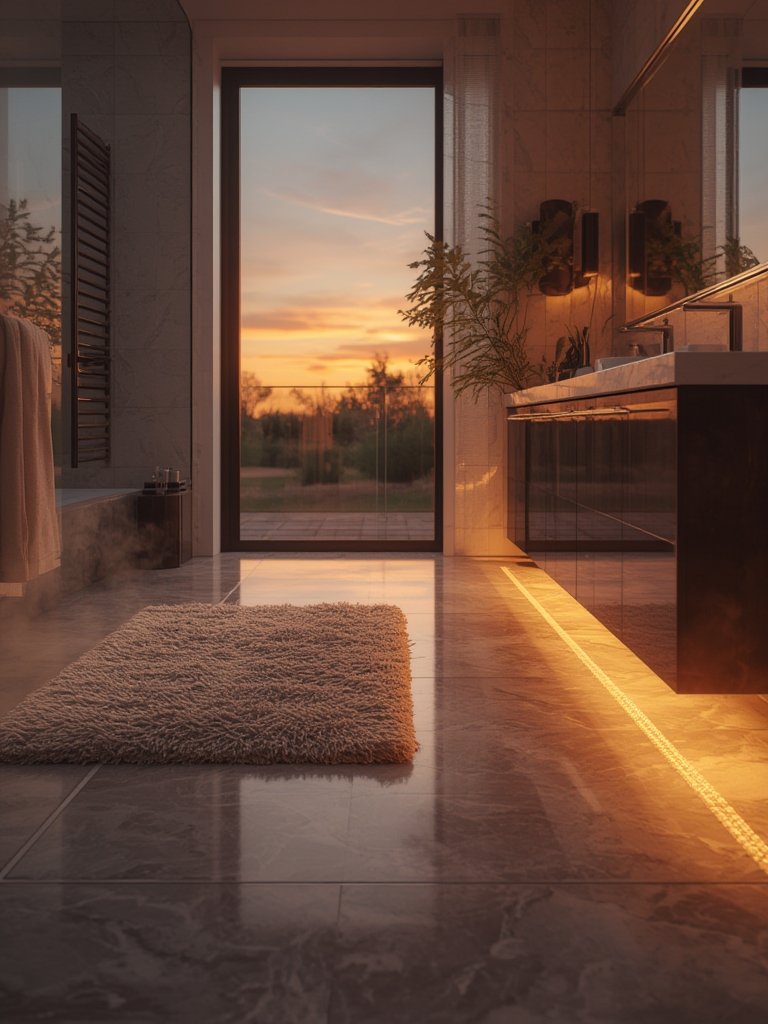
Practical recommendation & CTA for luxury renovation clients
If you want heated bathroom floors that truly perform—delivering both daily comfort and lasting resale upside—anchor your choice in real-world data, technical specs, and transparent installation quotes.
Decision matrix:
- For new construction or full-gut renovations (especially large master suites): Prioritize hydronic radiant floor heating if you plan for long-term savings and heat pump integration, provided project scope and budget allow.
- For luxury ensuite retrofits or budget-sensitive projects: Lean toward high-efficiency electric floor warming systems, especially when downtime or floor buildup must be minimal.
- For spa-like comfort on demand: Insist on programmable thermostats (zoned control) and get written floor finish compatibility from installer and manufacturer.
Next steps: Request at least three detailed quotes, ask about full-system warranty coverage (tile, mat, controls), and require a technical site survey before committing. For total comfort and value in your next remodel, make sure heated bathroom floors are the right fit—fully informed, not just trendy.
FAQ
Will installing heated bathroom floors increase my home’s resale value?
While heated bathroom floors signal luxury and can be a strong selling point, research reports (2024) found no quantified data on direct resale premiums. Their value is strongest in market appeal, comfort, and silent operation.
Are heated bathroom floors energy efficient?
Yes, both hydronic and electric underfloor heating systems are more efficient than forced air in most cases, especially in well-insulated homes. Efficiency is highest with hydronic systems paired with heat pumps, or electric systems managed by smart thermostats.
Can I install radiant floor heating under any bathroom flooring?
Tile and stone are most compatible, as they conduct heat well. Vinyl, engineered wood, and laminate may require special systems—always check manufacturer documentation and warranty conditions before proceeding.
What’s the biggest risk with heated bathroom floors?
If improperly installed, both hydronic and electric systems can be costly to repair and may require full tile removal. High upfront cost and warranty gaps are other common issues—always vet your installer and demand documentation.